CasiOak Buying Guide: Which G-Shock 2100 Should You Buy?
Understand the G-Shock 2100 families: resin, solar Bluetooth, metal-covered, steel bracelet and full metal, plus compact CasiOak alternatives.
October 2, 2026The G-Shock square range looks like a straightforward ladder until you read the references. One watch adds solar charging. Another adds radio reception. A third adds phone connectivity. A metal bezel can sit over a resin case and a conventional battery, while a full-metal model combines a steel case and bracelet with a different feature package. The useful question is not how far up the range you can climb. It is where you should stop. This guide focuses on the classic square buying decision and the adjacent 5000 full-metal branch. It is not a catalogue of every square colourway, compact version, specialist model or collector reference.
Start with the GW-M5610U-1ER if you want a resin square with solar charging and phone-free radio time adjustment. Choose the DW-5600UE-1 for conventional-battery simplicity, or the G-5600UE-1 for solar power without radio or Bluetooth. Choose the GW-BX5600-1 when phone-linked adjustment and a configurable MIP display matter. For metal, distinguish the battery-powered, metal-covered GM-5600U-1 from the full-metal, solar/radio/Bluetooth GMW-B5000D-1 and GMW-BZ5000D-1. These are different purchase routes, not interchangeable upgrades.
There are four decisions to make: power, time adjustment, display and construction. Keep them separate until you have a reason to combine them.
A conventional battery supplies power until it needs replacing. Tough Solar charges a rechargeable battery from light. Solar does not mean automatic time setting: the G-5600UE-1 has solar power but no radio-controlled or Bluetooth adjustment in its published feature set.
Multi Band 6 receives time-calibration radio signals. It does not use a phone to obtain those signals. Bluetooth links a compatible phone and app to the watch. Some squares have both radio reception and Bluetooth; the GW-BX5600-1 is one example.
Then choose the exterior. A stainless-steel bezel cover does not turn a resin-body square into a full-metal watch. Nor does it automatically add solar charging or phone connectivity. The GM-5600U-1 makes that distinction particularly clear.
Finally, look at the display. The GW-BX5600-1 and GMW-BZ5000D-1 use MIP LCDs with configurable layouts. The GMW-B5000D-1 instead uses an STN LCD. Full metal and MIP are therefore separate choices too.
Related guideHow to choose your first watch →
The table uses exact-reference specifications from Casio’s international pages, except the UK-listed GW-M5610U-1ER. Regional labels should be checked against the watch a US seller will actually supply.
| Exact reference | Power | Multi Band 6 | Bluetooth | Construction and band | Reason to choose it |
|---|---|---|---|---|---|
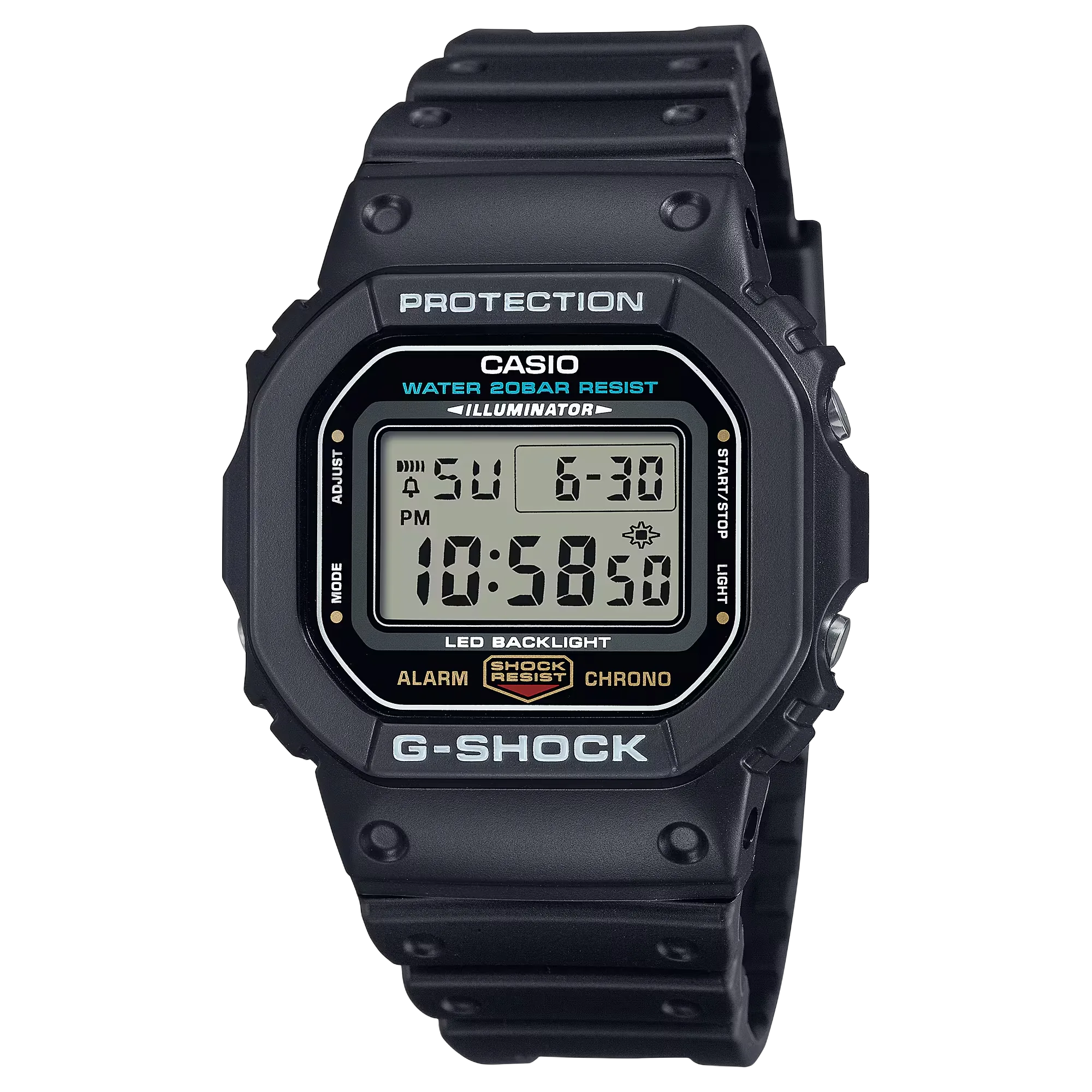
| DW-5600UE-1 | Conventional battery | No | No | Resin case/bezel and resin band | Basic digital square without charging or synchronization features |
| G-5600UE-1 | Tough Solar | No | No | Resin case/bezel and resin band | Solar charging while keeping time adjustment separate |
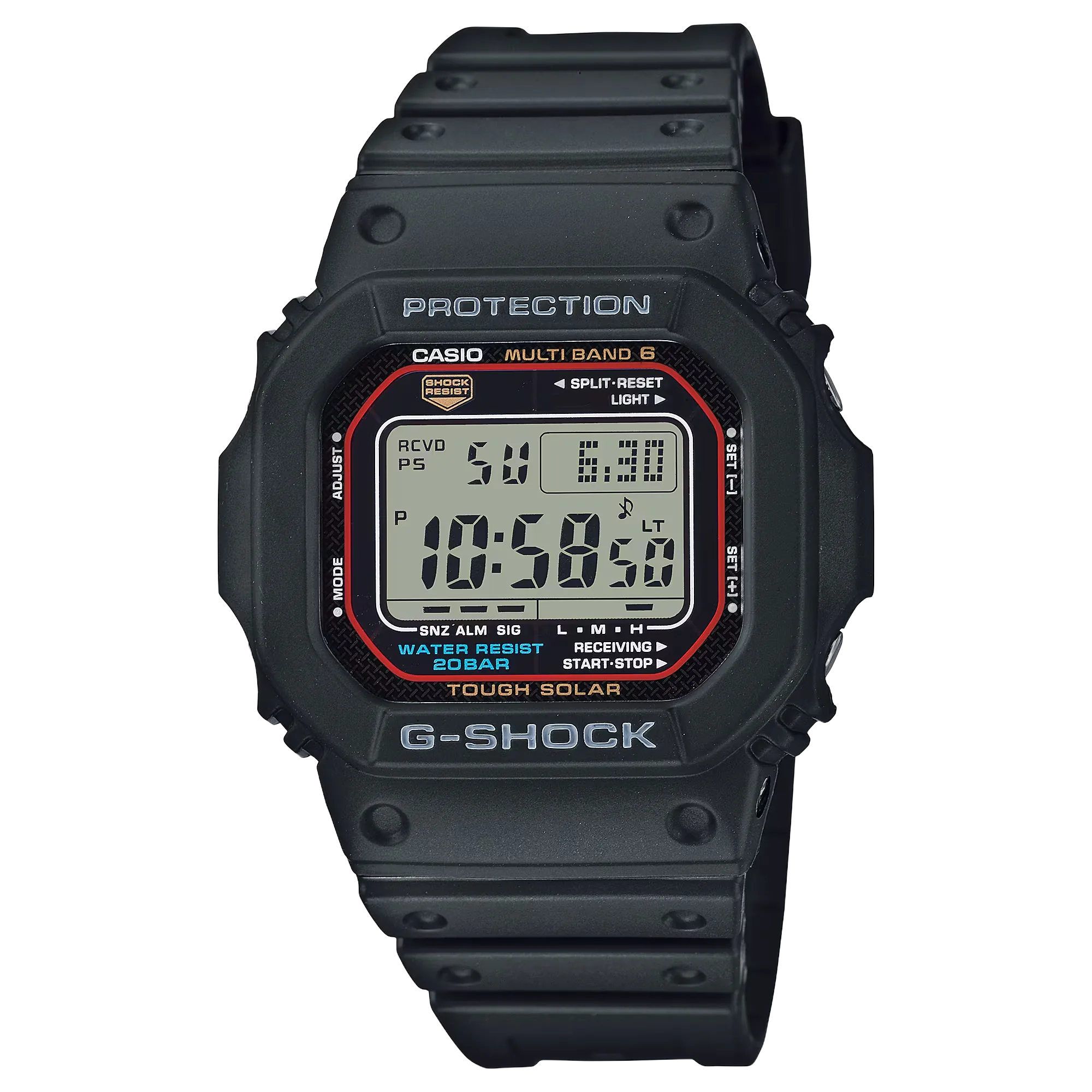
| GW-M5610U-1ER | Tough Solar | Yes | No | Resin case/bezel and resin band | Radio adjustment without phone pairing |
| GW-BX5600-1 | Tough Solar | Yes | Yes | Resin/bio-based-resin case/bezel and bio-based resin band | Connected square with a configurable MIP display |
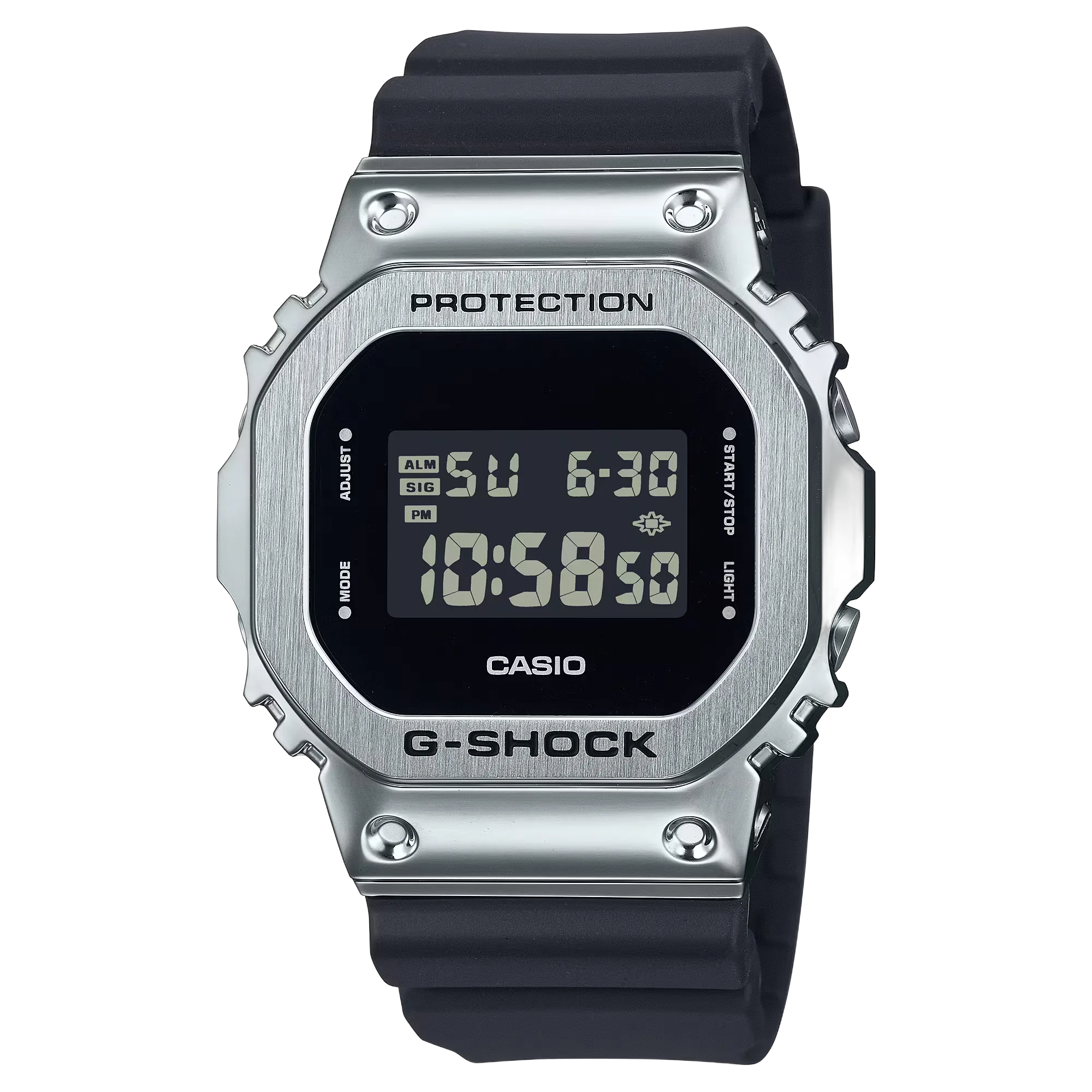
| GM-5600U-1 | Conventional battery | No | No | Resin body, stainless-steel bezel cover and resin band | Metal appearance without a steel bracelet or solar/connected package |
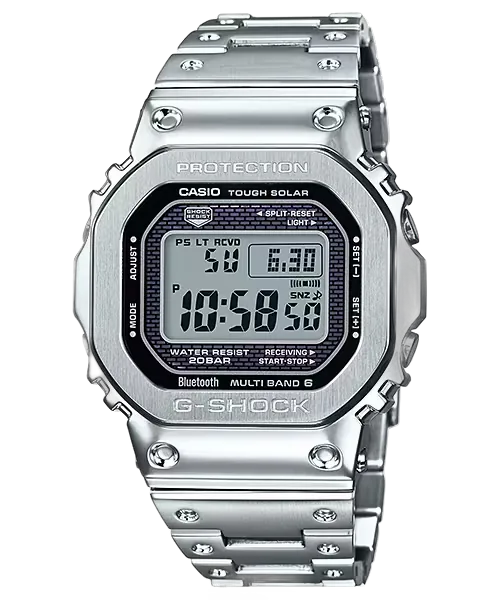
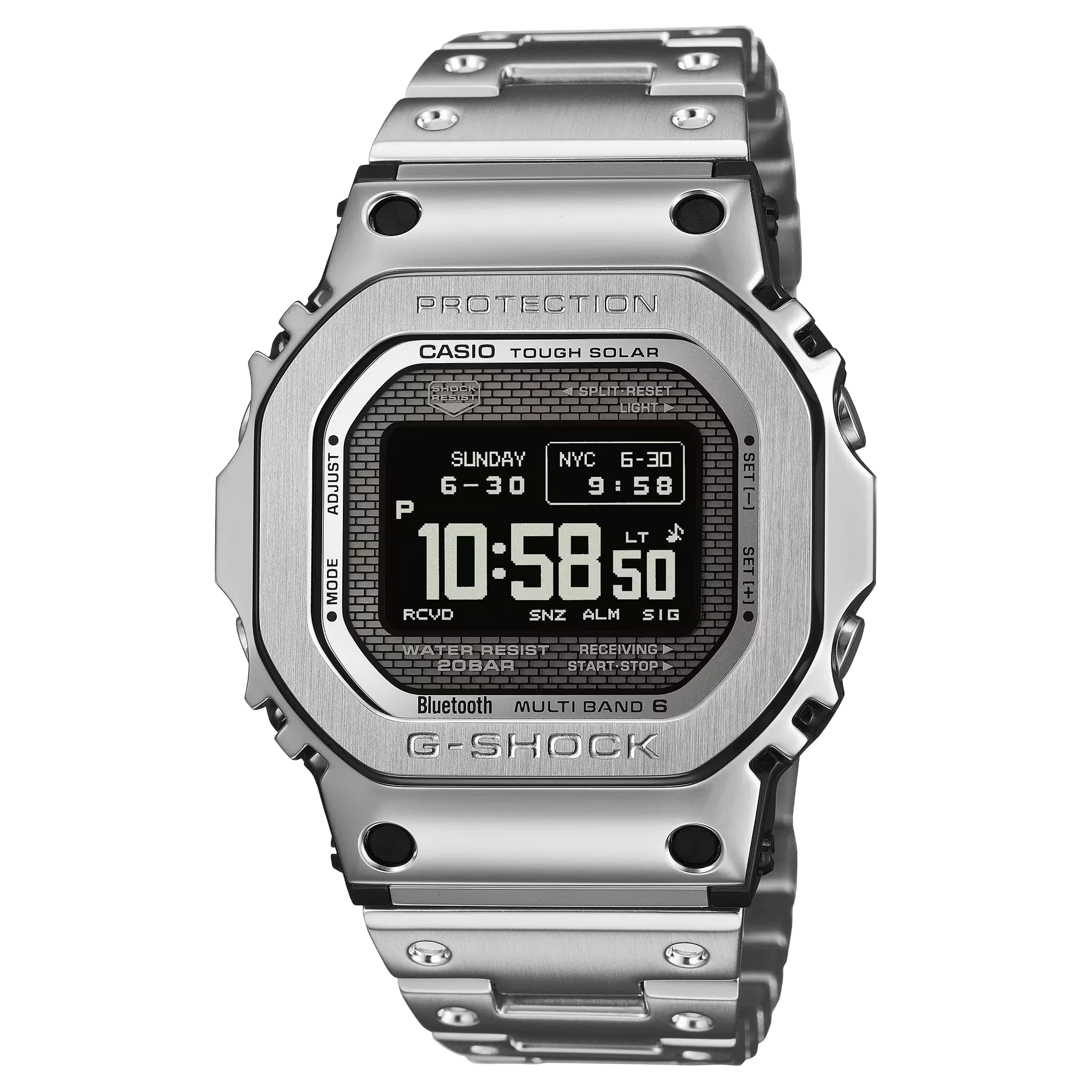
| GMW-B5000D-1 | Tough Solar | Yes | Yes | Stainless-steel case/bezel and steel bracelet | Full-metal construction with STN LCD |
| GMW-BZ5000D-1 | Tough Solar | Yes | Yes | Stainless-steel case/bezel and steel bracelet | Full-metal construction with configurable MIP LCD |
All seven named references have shock-resistant construction, mineral glass and a manufacturer-rated 200 metres of water resistance. Paying for a different exterior or display does not buy a higher water-resistance rating among these selections.
Best for: Someone who wants a straightforward square and is content to set the time manually.
Why it works: Casio specifies an approximately five-year battery life on a CR2016, a white LED backlight, a stopwatch, a 24-hour countdown with auto-repeat and a multi-function alarm. Its case is 48.9 × 42.8 × 13.4 mm and its weight is 52 g.
Watch-outs: This exact model does not supply the solar, radio or Bluetooth functions that distinguish the other technology routes. Its case length also means “basic” is not a synonym for “smallest.”
Choose it when its actual selling price and uncomplicated feature set suit you. Do not discard it simply because a more elaborate square exists.
Best for: Someone who wants solar charging but does not need radio reception or a phone connection.
Why it works: The G-5600UE-1 combines Tough Solar with a 46.7 × 43.2 × 12.7 mm resin case and a 51 g weight. It also supplies world time, five daily alarms including a snooze alarm, and a full-auto LED backlight.
Watch-outs: Solar is the power system, not a time-synchronization method. The published exact-reference specification does not include Multi Band 6 or Bluetooth. It is not the same watch as the similarly named GW-M5610U.
Choose it when you specifically want the solar-only route. If a radio-controlled square costs about the same in the offers you are considering, decide whether that extra function is useful rather than assuming the simpler model must be the cheaper purchase.
Related guideSolar watches buying guide →
Best for: Someone who wants the resin square format, solar power and radio adjustment without pairing an app.
Why it works: The UK-listed exact reference combines Tough Solar and Multi Band 6 in a 46.7 × 43.2 × 12.7 mm case, at 52 g. Its functions include world time, five daily alarms including snooze, and a full-auto white LED backlight.
Watch-outs: Multi Band 6 is not satellite synchronization or a guarantee of reception everywhere. Casio identifies compatible transmissions in Japan, North America, the UK, Germany and China, and recommends favorable reception locations such as near a window. Check whether radio adjustment makes sense where you will use the watch.
Choose it as the default starting point when those functions are useful and the case fits. This is an editorial recommendation based on its feature combination, not a claim that it wins every display, fit or price comparison.
Best for: Someone who wants solar power, radio reception and phone-linked setting, and also values configurable digital layouts.
Why it works: The GW-BX5600-1 adds an MIP LCD to Tough Solar, Multi Band 6 and Bluetooth through CASIO WATCHES. Casio provides four time-mode layouts and two main font styles; changing the font uses the app. The case is 49.1 × 44.1 × 13.4 mm and the watch weighs 51 g.
Watch-outs: It is not the same physical upgrade as adding a feature to the GW-M5610U-1ER. The BX is 2.4 mm longer, 0.9 mm wider and 0.7 mm thicker, although 1 g lighter in these published specifications. A low weight does not erase the larger footprint.
Casio describes the MIP display as higher-contrast with a wider viewing angle. That is a manufacturer claim, not a controlled readability test conducted for this guide. Check your preferred layout and display in person if possible.
Choose it when both the connected functions and the display change justify the purchase. If you mainly want radio-adjusted time in the shorter case, the M5610U remains a different and reasonable route.
Best for: Someone who wants a steel bezel around the square design but prefers a resin band and a conventional battery.
Why it works: Casio describes resin inside the case with a stainless-steel bezel cover. The exact reference measures 49.6 × 43.2 × 12.9 mm, weighs 73 g, and has an approximately five-year CR2016 battery estimate with a white LED backlight.
Watch-outs: It does not acquire Tough Solar, Multi Band 6 or Bluetooth because the exterior includes steel. Casio also identifies an inverted LCD on this reference; check that exact display rather than assuming all metal-covered squares have the same colour or contrast.
Choose it for the appearance and material combination. Compared with the selected resin DW-5600UE-1, it is 21 g heavier; it is not the “more advanced electronics” step in this guide.
Best for: Someone who specifically wants a steel case and bracelet, not merely a metal bezel cover.
Why the B5000 works: The GMW-B5000D-1 has a stainless-steel case, solid steel bracelet, one-touch three-fold clasp and screw-lock case back. Its STN LCD sits alongside Tough Solar, Multi Band 6 and Bluetooth. The published size is 49.3 × 43.2 × 13 mm and the weight is 167 g.
Why consider the BZ5000: The GMW-BZ5000D-1 changes the exterior structure and uses an MIP LCD with four time-mode layouts and two font styles, while retaining solar power, radio reception and Bluetooth. It measures 49.3 × 43.6 × 13 mm and weighs 172 g, with a solid steel bracelet, one-touch three-fold clasp and screw-lock back.
Watch-outs: Neither is a weight-neutral upgrade from a resin square. The B5000D is 115 g heavier than the selected M5610U; the BZ5000D is 120 g heavier. Their bracelets also need evaluating after sizing, not merely laid flat beside a resin watch.
Choose the B5000D when you want its steel construction and STN display. Choose the BZ5000D when the MIP layouts and different exterior are part of what you want. Buying the B5000D does not buy the BZ model’s MIP display, and buying the GM-5600U does not buy either watch’s full-metal construction or synchronization package.
Bluetooth does not necessarily mean solar. The earlier DW-B5600G-1 is a useful example: its exact specification combines Bluetooth with a conventional CR2016 battery and an approximately three-year battery estimate. It is not the Tough Solar/Multi Band 6 package described for the GW-B5600-2.
The earlier GW-B5600-2 combines solar, radio and Bluetooth in a 48.9 × 42.8 × 13.4 mm case at 53 g. It has an inverted LCD with a blue dial surround, not the BX model’s MIP display. If you are considering an older-stock or pre-owned example, compare its actual price, condition and display with the newer-display route rather than treating both references as the same watch.
These earlier references illustrate feature combinations; they are not a claim that either is currently stocked by Casio in the US.
Generation letters matter too. The GM-5600-1 is listed with an electroluminescent backlight and an approximately two-year battery estimate. The GM-5600U-1 here has LED illumination and an approximately five-year estimate. Do not copy the U model’s specification onto an older non-U listing.
Read case dimensions as length × width × height. They are not round-watch diameters or independently measured lug-to-lug spans. A steel bracelet also changes the assembled configuration, so compare the watch as you would actually wear it.
Casio lists 145–205 mm compatible band ranges for the DW-5600UE-1, GW-M5610U-1ER and GW-BX5600-1, versus 145–215 mm for the GM-5600U-1. The BZ5000D’s listed steel-band range is 150–205 mm. Those are manufacturer compatibility ranges, not guarantees of comfort or interchangeability between straps.
Check whether the case sits securely, whether the band wraps without pressure and whether the clasp or buckle lands comfortably. If fit is the main constraint, a more expensive standard square is not automatically the answer.
When comparing offers, identify the exact reference, configuration and warranty basis before calculating the price gap. Spend more only if you can name what you gain: light charging, phone-free correction, phone-linked settings, a different display, a steel bezel or a steel case and bracelet.
Do not expect that extra spending always improves every function. The DW-5600UE-1 and GM-5600U-1 have auto-repeat countdown timers, whereas that function is not listed for the selected solar/connected references. If repeat timing matters, preserve it in your comparison rather than letting the feature ladder make the decision for you.
The simplest buying rule is to choose power and adjustment first, display second, and exterior third. Stop at the combination that fits your wrist and actual purchase budget. A radio/solar resin square can be the final answer; a metal-covered battery model can be the intentional choice; and a full-metal square should be bought because you want that construction, not because you feel obliged to finish the ladder.
Take the 10h09 quiz to narrow your watch shortlist by budget, wrist fit, style and the features you will actually use.
Related guideWatches for small wrists →
“Buy the function you need and the construction you want — not the assumption that every square above yours is better.”
No. The G-5600UE-1 has Tough Solar but no Multi Band 6 or Bluetooth in its published feature set. The GW-M5610U-1ER adds radio reception, while the GW-BX5600-1 combines radio and phone connectivity. Power and synchronization are separate decisions.
No. Bluetooth describes communication, not the power supply. The earlier DW-B5600G-1 uses a conventional CR2016 battery, while the GW-BX5600-1 is solar-powered. Solar still uses a rechargeable battery; it is not a battery-free watch.
No. The GM-5600U-1 uses a resin body with a stainless-steel bezel cover and a resin band. The GMW-B5000D-1 and GMW-BZ5000D-1 have stainless-steel cases and bracelets, plus solar power, radio reception and Bluetooth. The metal-covered reference has a conventional battery and none of those synchronization systems.
The B5000D-1 uses an STN LCD; the BZ5000D-1 uses an MIP LCD with selectable layouts and font styles, and a different exterior structure. Both have the solar, radio and Bluetooth combination. Their listed weights are 167 g and 172 g respectively, so the display upgrade is not a reduction in overall weight.
The GW-M5610U-1ER is this guide’s starting point for someone who wants a resin square, can use radio reception and values solar power without phone pairing. Choose the DW-5600UE-1 if conventional batteries meet your needs at the offered price, or the GW-BX5600-1 if connected settings and MIP layouts matter more. Fit and exact configuration can overrule the default.
Understand the G-Shock 2100 families: resin, solar Bluetooth, metal-covered, steel bracelet and full metal, plus compact CasiOak alternatives.
October 2, 2026Explore Casio G-SHOCK through its squares, 2100 designs and metal models. Understand the features, wrist fit and trade-offs before choosing yours.
October 2, 2026Are G-SHOCK watches worth buying? Compare their durability, fit and features with a basic Casio, and learn which upgrades justify the cost.
October 6, 2026Choose the right G-SHOCK for everyday wear, work, travel or outdoor activities. Compare four exact models, useful features and fit trade-offs.
October 6, 2026