CasiOak Buying Guide: Which G-Shock 2100 Should You Buy?
Understand the G-Shock 2100 families: resin, solar Bluetooth, metal-covered, steel bracelet and full metal, plus compact CasiOak alternatives.
October 2, 2026G-SHOCK is easy to recognise and surprisingly difficult to choose. A square digital watch in black resin, an octagonal model with analogue hands, and a carefully finished metal watch can all carry the same name, yet answer quite different needs. Toughness explains what connects them. It does not explain which one you should buy. The useful starting point is not the longest specification list or the most expensive reference. It is the shape you want to wear, the display you want to read, and how much attention you want to give the watch. Solar charging, automatic time adjustment and upgraded materials become meaningful only after those decisions. This spotlight maps the range through three accessible entry points: the original square, the 2100 family, and the move into metal and premium finishing. It is not an exhaustive catalogue. It is a way to understand G-SHOCK before getting lost in the references.
Start with the square if you want G-SHOCK's original digital identity, or the 2100 family if you prefer analogue hands. Confirm the fit and display, then decide whether solar charging, automatic time adjustment or metal construction is worth choosing.
G-SHOCK began with a practical problem rather than a styling brief. In 1981, Casio engineer Kikuo Ibe dropped and broke a watch his father had given him, and set out to build one that would not break the same way. His proposal became known inside Casio as the “Triple 10” brief: resistance to a 10-metre drop, 10-bar water resistance, and a 10-year battery life. By Casio's own account, reaching a workable construction took more than 200 prototypes and about two years of testing under what Ibe called Project Team Tough.
The solution was not a thicker case. Ibe took his cue from watching a rubber ball bounce in a park: the centre of a ball stays protected through an impact, so a similarly suspended module should too. The watch's electronics were mounted inside the case with a small number of contact points, so impacts reached the structure rather than the components. That “floating module” principle still underlies G-SHOCK construction today.
The first model, the DW-5000C, went on sale in April 1983. Casio's own brand history records how the range found its audience outside Japan: the DW-5900C became a hit with skateboarders on the US West Coast after its 1990 release outside Japan, and through the 1990s G-SHOCK spread through street culture more broadly as musicians and other entertainment figures started wearing it.
The result is a watch family whose appearance and engineering are closely connected. That does not make every G-SHOCK indestructible, nor every reference suitable for every activity. It explains why the range has a recognisable character even when its materials, displays and proportions change.
The following representative references show how much the range varies while keeping the same underlying idea. Dimensions are length × width × thickness, as Casio lists them.
| Reference | Family | Display | Size (mm) | Weight | Power |
|---|---|---|---|---|---|
| DW-5600UE-1 | Square 5600 | Digital | 48.9 × 42.8 × 13.4 | 52 g | Battery (CR2016) |
| GW-M5610U-1 | Square 5600 | Digital | 46.7 × 43.2 × 12.7 | 52 g | Tough Solar |
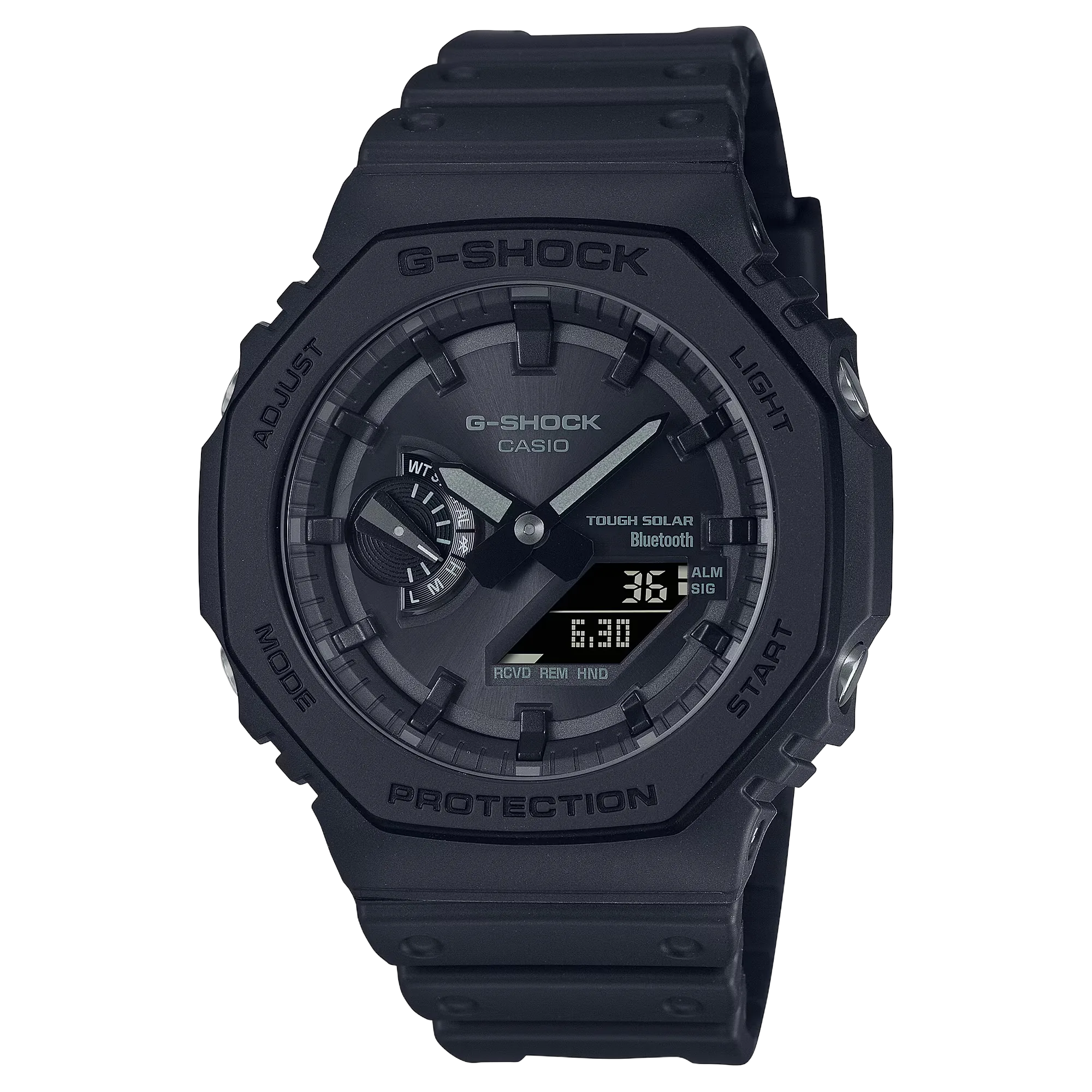
| GA-2100-1A1 | 2100 | Analog-digital | 48.5 × 45.4 × 11.8 | 51 g | Battery |
| GA-B2100-1A1 | 2100 | Analog-digital | 48.5 × 45.4 × 11.9 | 52 g | Tough Solar + Bluetooth |
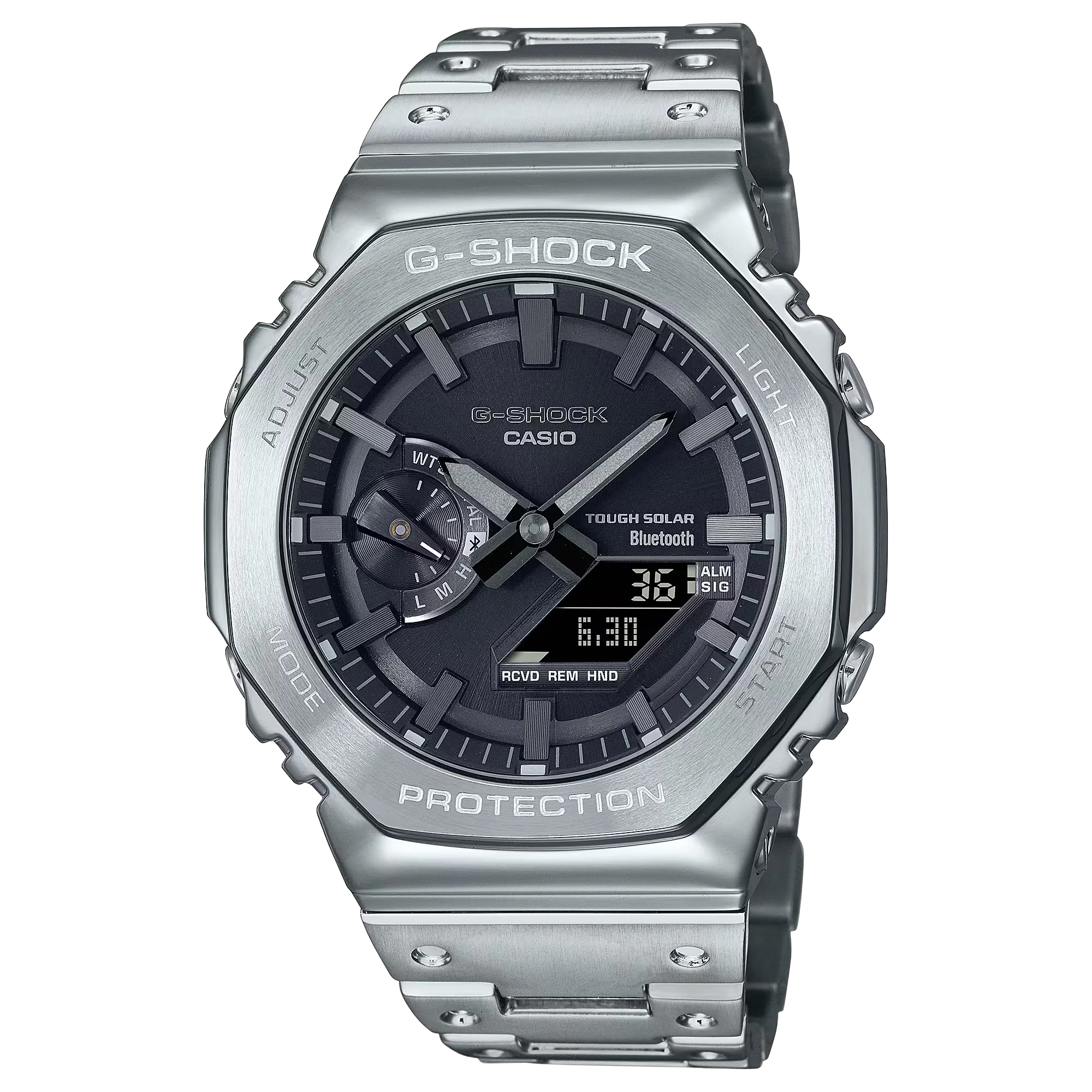
| GM-B2100 | 2100, full metal | Analog-digital | 49.8 × 44.4 × 12.8 | 165 g | Tough Solar + Bluetooth |
These are individual examples, not family-wide specifications. Check each reference's own page before buying.
The square is the most direct route into G-SHOCK's original design. The 5000 and 5600 families preserve the broad visual identity of the first model: a digital display framed by a protective, angular case.
Their appeal is clarity of purpose. There are no analogue hands to interpret, and the design makes no attempt to resemble a conventional mechanical sports watch. If that is what attracts you, a square is not a compromise before moving to something more expensive. It may be the design you wanted all along.
However, “a square G-SHOCK” does not describe one specification. Similar-looking watches can differ in dimensions, charging, time adjustment, display treatment and construction. The exact reference matters more than a quick glance at the case shape.
For a first purchase, separate two questions. Do you like the square's digital identity? And do you want a straightforward battery-powered watch or a version with additional ownership conveniences? Answering those questions makes the range easier to navigate.
The GA-2100 arrived in 2019, introducing an octagonal design with analogue hands and a small digital display. G-SHOCK had offered analogue hands before — the AW-500 of 1989 was the first analog-digital combination model — but the 2100 made the format central to its identity and quickly became one of the brand's most popular designs.
Its attraction is the combination of familiar time-reading and an unmistakably modern case. The hands provide the main time display, while the digital window carries additional information and functions. For someone who likes G-SHOCK's protective appearance but does not want a fully digital face, that changes the proposition.
The design is often nicknamed “CasiOak” by enthusiasts — an unofficial community name, not a Casio collection, coined for its resemblance to a well-known octagonal luxury sports watch. Treat the nickname as recognition, not a buying category: the 2100 family includes references with different materials, proportions and technologies.
The base GA-2100 and the solar-equipped GA-B2100 illustrate the distinction. They share a closely related silhouette, but the GA-B2100 adds Tough Solar and Bluetooth connectivity. Metal-clad and full-metal versions take the same broad design in another direction.
Choose this family because you prefer its face and proportions. Do not assume the analog-digital layout is automatically more useful than a square. If you frequently consult the timer, calendar or other digital information, consider how much display space those functions receive.
A metal G-SHOCK is not simply a resin watch with a higher price attached. Materials change the appearance, weight and relationship between the watch and the wrist. They can also change what the buyer values: finish and construction may become as important as practical functions.
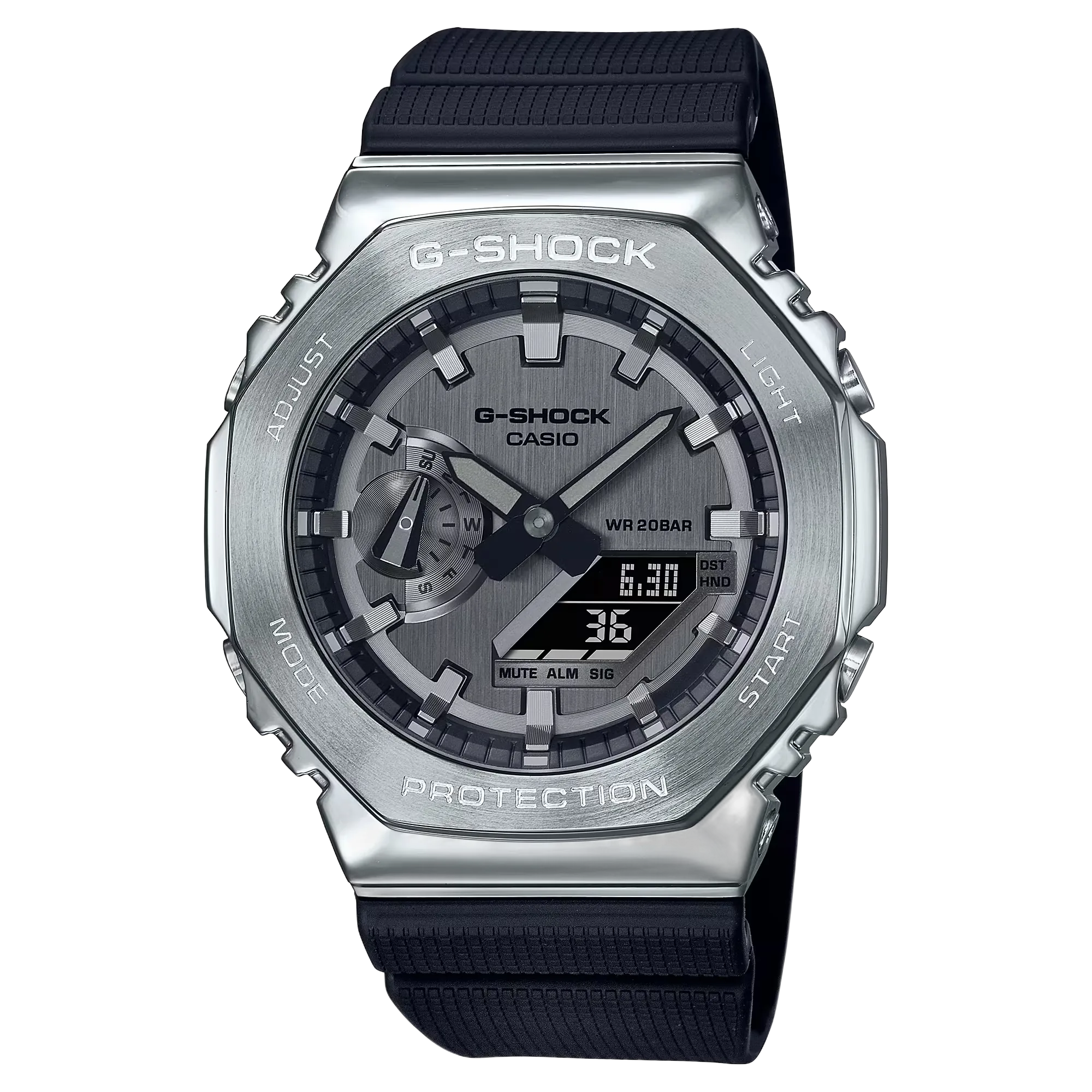
Within the 2100 range, distinguish metal-clad from full-metal construction. Casio describes the GM-2100 as metal-clad: a stainless-steel bezel mounted on a glass-fibre-reinforced resin inner case, with small protrusions reducing contact between the two to cushion shocks. The GM-B2100 goes further, with a stainless-steel case, bezel and bracelet, plus solar charging and Bluetooth connectivity.
This is not a simple progression from “less tough” to “more tough”. It is a choice between different executions of the same broad design idea.
At the premium end, MR-G — Casio's flagship G-SHOCK line, dating back to 1996 — brings a different materials-and-finishing conversation. Casio positions it around construction, surface finishing and Japanese craftsmanship. The MRG-B2100's dial, for example, is a three-dimensional latticework inspired by kigumi, a traditional Japanese wood-joinery technique, and Casio credits the fine processing technologies of its Yamagata Casio factory for making that level of precision possible.
The sensible question is whether you value that execution. A basic resin reference can already deliver the functions you need. Moving upward should be a deliberate purchase of materials, finishing or design — not an assumption that the simpler watch is incomplete.
Tough Solar and automatic time adjustment are often discussed together, but they solve different problems.
Solar charging addresses power. Casio's Tough Solar system converts light into electrical energy to charge a rechargeable battery. It reduces the need for routine battery replacement, but the watch still needs appropriate exposure to light. “Solar” should not be read as “needs no attention under any circumstances”.
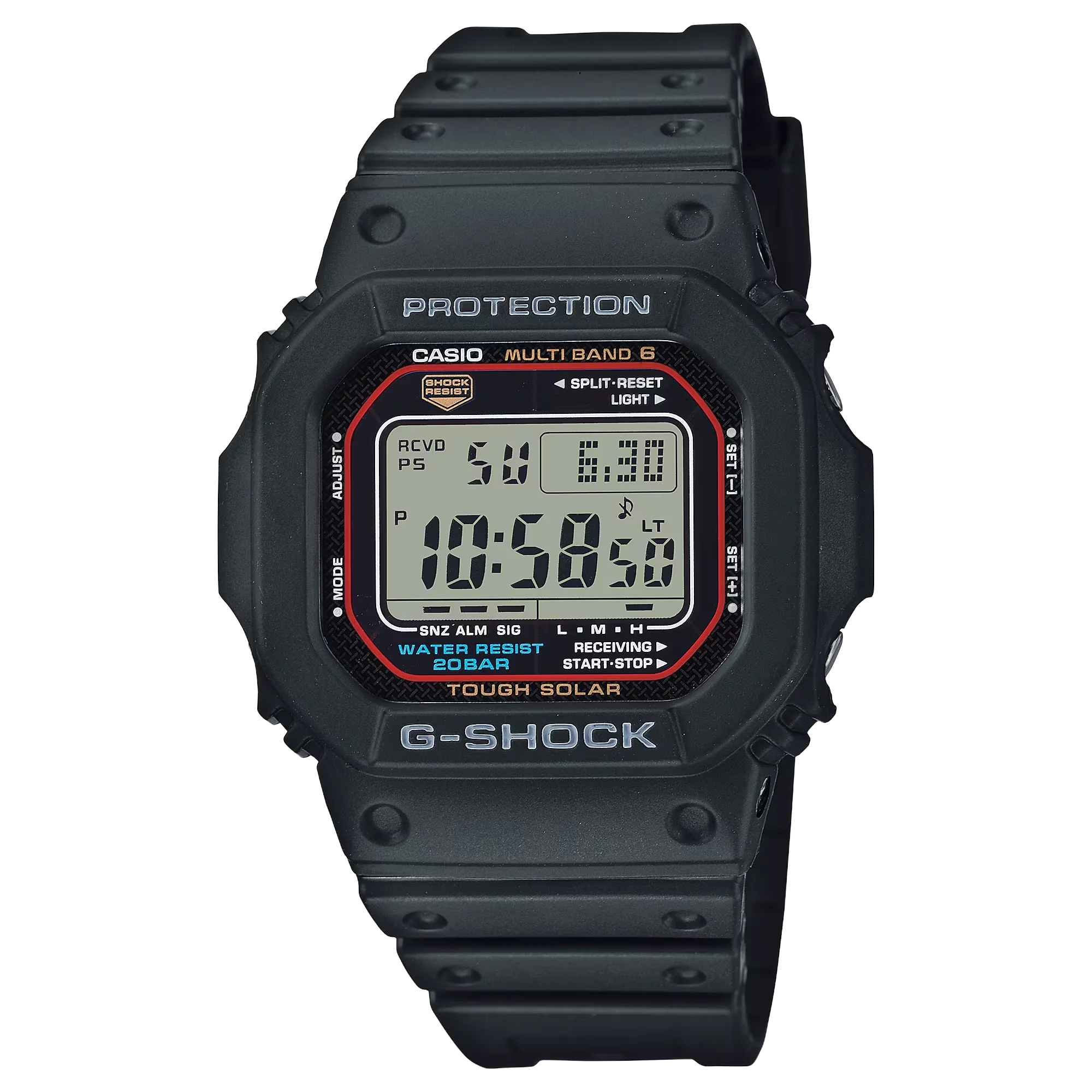
Radio-controlled timekeeping addresses setting. On the GW-M5610U-1, Multi Band 6 receives supported time-calibration signals. Reception depends on location and conditions; it is not a promise of automatic correction everywhere you travel.
Bluetooth provides another route to adjustment through a compatible smartphone and app. The GA-B2100 offers this alongside solar charging. That combination makes sense if you want the 2100 design with connected convenience, but it is not necessary to appreciate the base watch.
Choose these features according to ownership habits. If you dislike replacing batteries, solar is relevant. If you dislike checking and correcting the time, investigate the available adjustment system. If you want a watch independent of a phone connection, distinguish that preference from the question of solar power.
Related guideSolar watches buying guide →
G-SHOCK dimensions need to be read as a set. Casio commonly lists case length, width and thickness, and those measurements describe different aspects of the watch's presence.
For example, the DW-5600UE-1 measures 48.9 × 42.8 × 13.4 mm. The GW-M5610U-1 measures 46.7 × 43.2 × 12.7 mm. The second watch is slightly wider, yet shorter and thinner. Calling one “smaller” on the basis of width alone would miss useful information.
The same caution applies across shapes. An angular digital case and an octagonal analog-digital case distribute their visual mass differently. Strap behavior and how the watch sits on the wrist also deserve attention.
Use the measurements to identify candidates, not to deliver a universal fit verdict. Manufacturer band-size compatibility is not a guarantee that the watch will look or feel right on every wrist within that range.
Before buying, consider three practical questions: does the case sit comfortably, does its thickness work with your clothing, and do you enjoy its visual presence? Trying the watch on is the best way to resolve those questions when possible. Otherwise, look for photographs of the exact reference on a comparable wrist rather than relying on isolated product images.
Related guideWatches for small wrists →
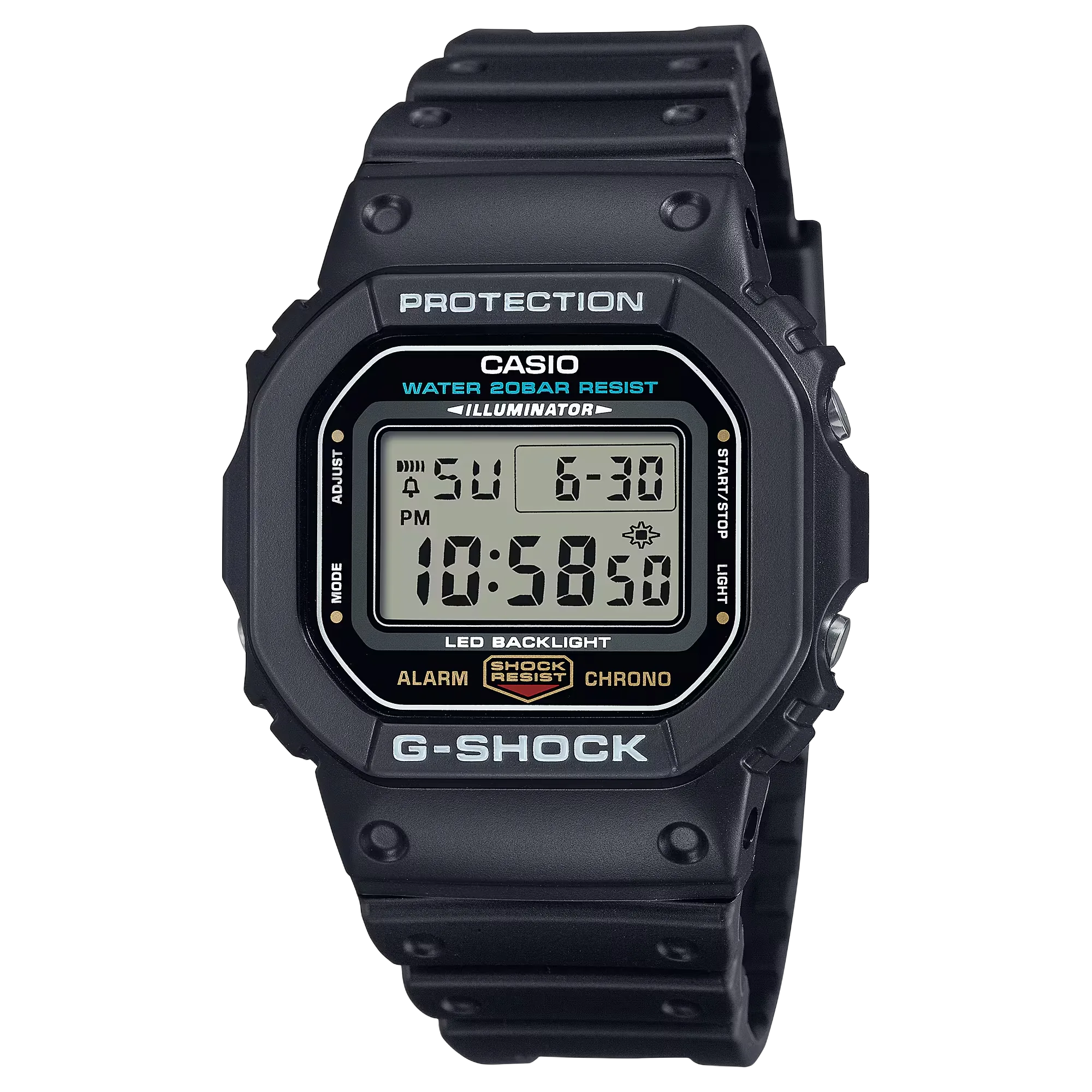
The DW-5600UE-1 is a useful example of G-SHOCK without charging or connectivity decisions. Its resin case and band, digital display and battery-powered operation keep the proposition direct.
Casio lists 200-metre water resistance and an approximate five-year battery life on a CR2016 cell, at a weight of 52 g. Its practical functions include a stopwatch, countdown timer, alarm and LED backlight.
Choose it if you want the square design and a straightforward set of everyday tools without a smartphone connection.
Think twice if solar charging or automatic time adjustment is already on your wish list. Those are reasons to choose another reference, not features to assume every square includes.
The GW-M5610U-1 adds Tough Solar and Multi Band 6 while retaining the recognisable square design. At 52 g, it illustrates how additional capability does not necessarily require moving into a heavier metal watch.
It is also shorter and thinner than the DW-5600UE-1 discussed above. That does not establish a universal comfort winner, but it is a useful reminder to check the actual reference rather than treating all squares as interchangeable.
Choose it if you want solar charging and supported radio-controlled adjustment without changing the basic design direction.
Think twice if you expect radio reception wherever you go, or if you would rather avoid thinking about charging conditions. Both technologies have operating requirements, even though they can reduce routine intervention.
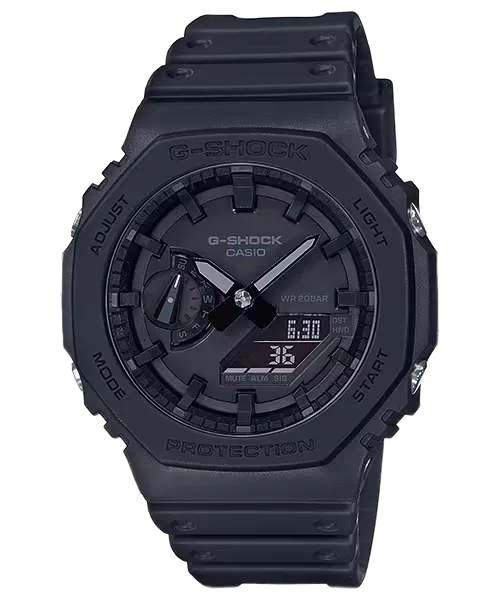
The GA-2100 is the reference point for the octagonal analog-digital design. Casio lists the standard format at 48.5 × 45.4 × 11.8 mm and 51 g. Its Carbon Core Guard construction uses a carbon-fibre-reinforced resin case to help protect the module.
The GA-B2100 keeps closely related proportions — 48.5 × 45.4 × 11.9 mm, approximately 52 g — while adding Tough Solar and Bluetooth. According to Casio, the GA-B2100 generation was the first in the 2100 line to add solar charging and smartphone connectivity.
Choose the GA-2100 if the design is the main attraction and you prefer conventional battery-powered operation. Consider the GA-B2100 if you want the same broad visual direction with solar charging and smartphone-linked time adjustment.
Think twice about either if your priority is a large digital display for frequent use of secondary functions. Compare the exact colourway, hand contrast and digital window rather than assuming that every version is equally suited to your reading preferences.
The full-metal GM-B2100 shows why a higher-tier G-SHOCK can be a different ownership choice rather than a necessary upgrade.
Casio's family comparison lists the GM-B2100 at 49.8 × 44.4 × 12.8 mm and 165 g. Against the 52 g GA-B2100, that is a substantial change in weight, even though the watches share an octagonal design direction and both offer solar charging and Bluetooth.
Choose it if the stainless-steel execution and bracelet are central to what you want from the watch.
Think twice if your favourite quality in a resin G-SHOCK is how little weight it adds. More metal is a material preference, not an automatic improvement in everyday wear.
Shock resistance does not tell you whether the display suits your eyes, whether the controls suit your habits, or whether the case works under your sleeve. Those are separate parts of choosing a watch.
Nor does a water-resistance rating settle every question about water use. The references discussed here have manufacturer-stated 200-metre ratings, but that is not a blanket claim that every model has the same diving credentials. Check the exact reference and its instructions for your intended activity.
The same restraint applies to price. Extra functions, metal construction and premium finishing can be worthwhile without being necessary. A more expensive G-SHOCK may suit your taste better, but it does not make a simple square the wrong purchase.
The aim is to buy the version whose compromises you accept, not the version with the fewest blank spaces in a specification table.
If the original digital identity is what draws you to G-SHOCK, start with a square. If you want analogue hands and the octagonal silhouette, start with the 2100 family. If materials and finishing are the main attraction, explore metal and premium models with their added weight and different ownership proposition in mind.
Then confirm the fit and display. Only after that should you decide whether solar charging, automatic time adjustment or another feature changes enough about daily use to justify choosing it.
10h09's own catalogue now carries a selection of G-SHOCK references across the square, 2100 and metal families — including every reference discussed above — so the quiz can genuinely point you toward one of these watches, not just something similar. Take the seven-question quiz to find out.
“Choose the G-SHOCK you want to wear first. Choose the technology second.”
G-SHOCK is a Casio watch brand, not a separate watch manufacturer. Its story begins with the DW-5000C in April 1983, but that date describes the launch of G-SHOCK rather than the founding of Casio: Casio's own history traces the company's roots to 1946.
The square is the original digital design direction, associated with the 5000 and 5600 families. The GA-2100, introduced in 2019, brought an octagonal case with analogue hands and a small digital display. Neither shape defines one fixed specification: charging, time adjustment, materials and dimensions vary by reference.
Solar charging is worth considering if reducing routine battery replacement matters to you. It does not automatically make the watch more suitable in every other respect. The display, case, functions and fit still need to match your preferences, and the rechargeable battery needs appropriate exposure to light.
Potentially, but judge the exact model rather than the brand as a whole. Check case length, width and thickness, then consider strap behavior and visual presence. G-SHOCK includes different case formats and smaller variants, but a band's stated compatibility range does not establish a universal comfort or appearance verdict.
Depending on the reference, the difference can include materials, bracelet construction, finishing, charging and time-adjustment systems. MR-G, the flagship range, places particular emphasis on premium construction and craftsmanship. Decide which of those differences you value rather than assuming the highest-priced watch is the best functional choice.
Understand the G-Shock 2100 families: resin, solar Bluetooth, metal-covered, steel bracelet and full metal, plus compact CasiOak alternatives.
October 2, 2026Are G-SHOCK watches worth buying? Compare their durability, fit and features with a basic Casio, and learn which upgrades justify the cost.
October 6, 2026Choose the right G-SHOCK for everyday wear, work, travel or outdoor activities. Compare four exact models, useful features and fit trade-offs.
October 6, 2026